
Vyasa
Brahmin rishi. Son of a fisher-girl. Compiler of the Vedas. Author of the Mahabharata. The reason any of it survived to be read.
| Era | Late Vedic / early Itihasa — c. 3000 BCE in tradition; first millennium BCE in scholarship |
| Lineage | Brahmin · son of Rishi Parashara |
| Mother | Satyavati — a fisher-girl of the Yamuna |
| Tradition | Veda Vyasa · Itihasa-Purana parampara |
| Works | The four Vedas (compiled) · Mahabharata · 18 Puranas · Brahma Sūtras |
| Sons | Shuka · Dhritarashtra · Pandu · Vidura |
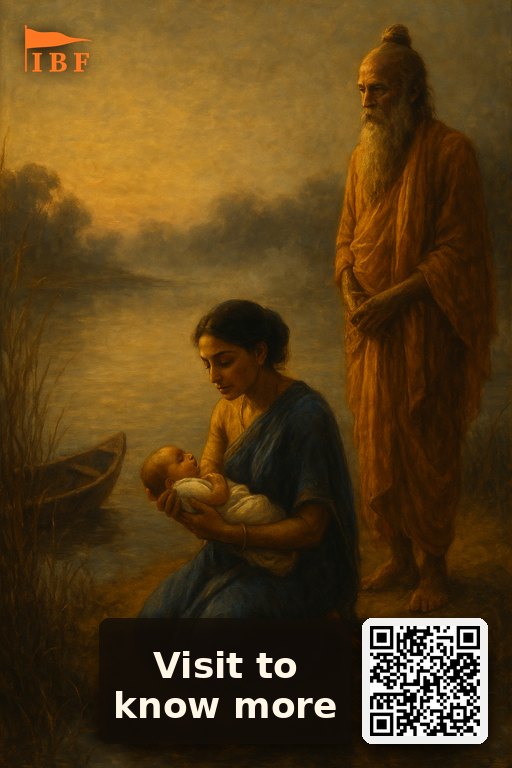
Born on an Island
On a small island in the Yamuna, a fisher-girl named Satyavati was visited by a wandering rishi.
His name was Parashara. He was a Brahmin, a grandson of Vasishtha, descended from the Saptarishi line — the seven Brahmin sages who carry the Vedic tradition between cosmic ages.
The boy born of that meeting was called Krishna Dwaipayana — Krishna because of his dark complexion, Dwaipayana because he was born on an island (dvīpa).
His mother kissed him once and let him go. The Brahmin child of a Brahmin father, raised in no Brahmin household.
He walked into the forest at birth and into the parampara at the same instant. The rishis raised him. They taught him every śruti they knew. By the time he was a young man, he had absorbed more Vedic recitation than any Brahmin alive.
And he had begun to worry that it was about to be lost.
The Boy Who Refused to Be a Householder
The Vedas were not yet written. They were memorised. Passed from a Brahmin guru's mouth to a Brahmin disciple's ear, syllable by syllable, intonation by intonation, generation by generation. Śruti — that which is heard.
It worked for centuries. But Dwaipayana could see the lifespans shrinking. He could see the memory weakening. The Kali Yuga was beginning. Soon the human capacity to carry the Vedas in a single mind would not hold.
His mother begged him to settle, marry, have grandsons. He refused. He had work.
He took the name his work would give him: Veda Vyāsa — the Arranger of the Veda.
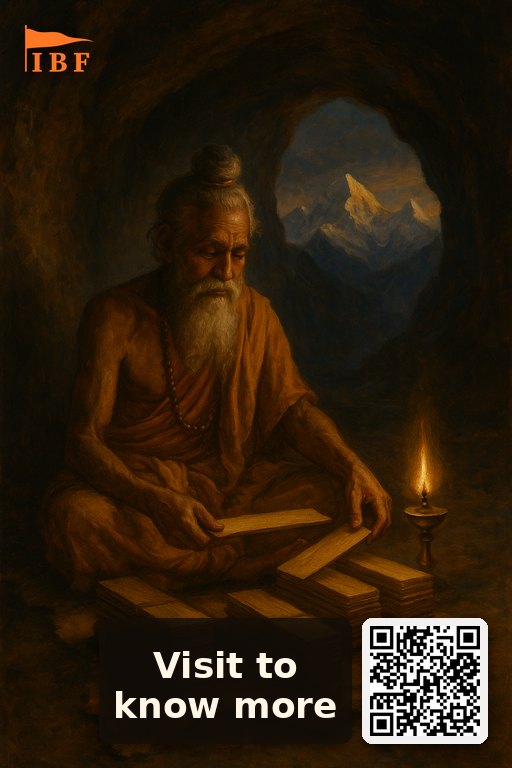
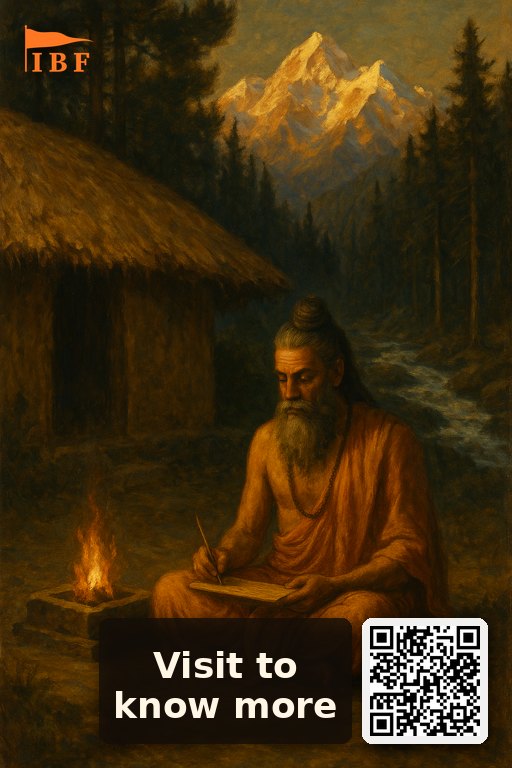
He sat down at a cave near Badrinath, in the high Himalayas. He had decided to do what no one before him had done: take the single living body of Vedic knowledge and divide it.
The Compilation
He arranged the mantras into four collections. Each one would have its own keeper. Each one would survive even if the others were lost.
| Veda | Domain | First disciple |
|---|---|---|
| Ṛgveda | Hymns of praise | Paila |
| Yajurveda | Ritual formulas | Vaishampayana |
| Sāmaveda | Melodies | Jaimini |
| Atharvaveda | Incantations | Sumantu |
Four Brahmin disciples. Four Vedas. Each one charged with carrying his portion forward and teaching it to a new generation, who would teach it to theirs, in the unbroken parampara.
This is the first preservation act in the history of the subcontinent. Without it, no Upaniṣad. No Gītā. No Shankara. No Rāmānuja. No Sanātana Dharma as we know it.
“Vyāsocchiṣṭam jagat sarvam — The entire world is the leavings of Vyasa's plate.”
The Eighteen Parvas
The Vedas were safe. But Vyasa was not finished.
He saw the world entering a darker age. The old kṣatriya code was breaking. Brothers were turning on brothers. A great war was coming — the war between the Kauravas and the Pāṇḍavas, his own grandsons on both sides.
He set out to record everything. Not just the war. The world that produced it. The Vedic order, the genealogies, the codes of conduct, the philosophical conversations on the eve of battle, the cosmic accounting of dharma when human beings fail to follow it.
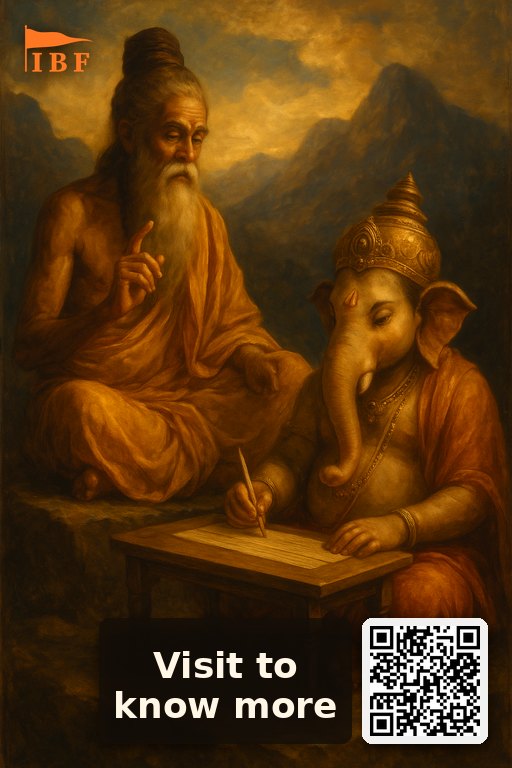
He dictated the Mahābhārata to Ganesha, who broke off his own tusk to write it down. One hundred thousand verses. Eighteen parvas. Ten times longer than the Iliad and the Odyssey combined.
Inside it, he placed the Bhagavad Gītā — seven hundred verses where Kṛṣṇa, Brahmin-instructed cowherd-king, teaches a faltering warrior the architecture of duty.
The Gītā has been read continuously for two thousand years. It is the central text of the Brahmin philosophical inheritance — and it sits inside Vyasa's Mahābhārata like a heart inside a body.
Witness to a War
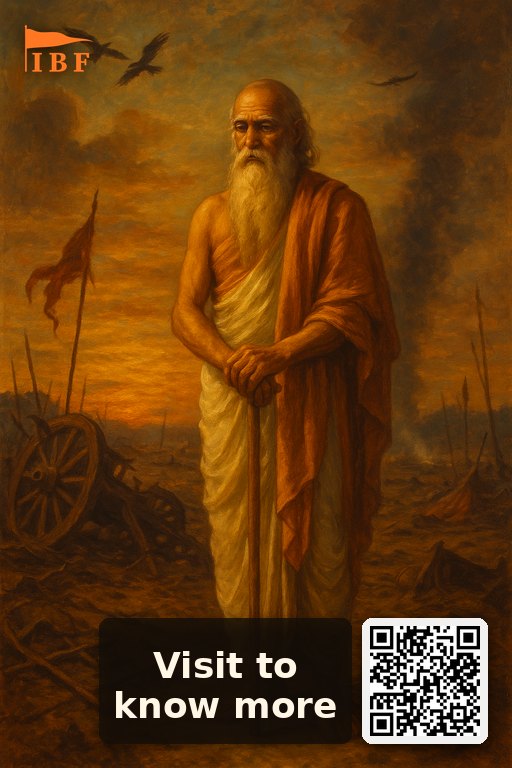
The Kurukshetra war happened. Vyasa watched it. He had warned the Kauravas. He had counselled Dhritarashtra, his own son. None of them listened.
When it ended — eighteen days, eighteen akṣauhiṇīs, almost the entire Kshatriya population of north India dead — he was the one left to bury and to record.
He gave the throne to Yudhishthira. He gave the Pāṇḍavas the dharma teachings they had failed to absorb during the war: the Śānti Parva, the Anuśāsana Parva. The longest sermon ever delivered by a Brahmin to a victorious king.
Then he climbed back into the Himalayas.
“Dharmasya tattvaṃ nihitaṃ guhāyām — The truth of dharma is hidden in a cave.”
The Eighteen Puranas
Vyasa was still not finished.
The Vedas were for the twice-born. The Mahābhārata was for the kṣatriyas. But what about the rest — the artisans, the farmers, the women, the children who would never sit in a gurukula?
He composed the Eighteen Mahāpurāṇas. Bhāgavata. Viṣṇu. Śiva. Skanda. Mārkaṇḍeya. Vāyu. Brahma. Agni. Eighteen books of cosmology and lineage and devotional story — the Vedic teaching translated into narrative that any Hindu could remember.
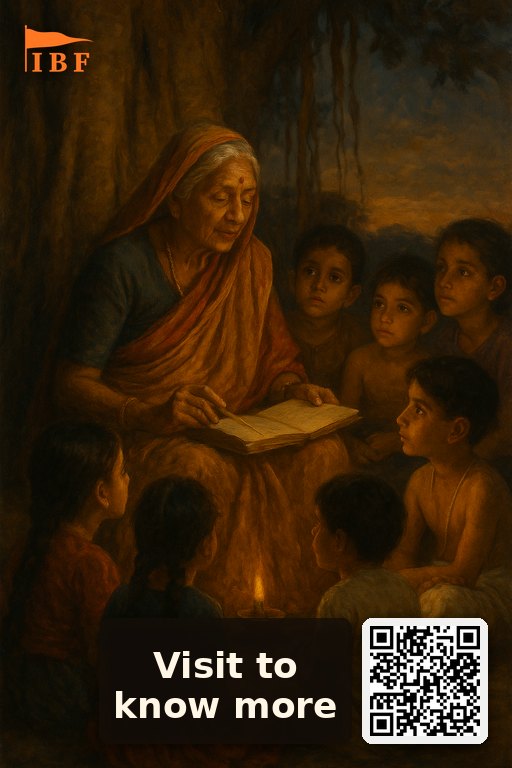
The Puranas are the reason a Brahmin grandmother in a village can tell the same Kṛṣṇa story that an Acharya in a matha discusses philosophically. The same tradition, two registers, one source.
He also wrote the Brahma Sūtras — 555 aphorisms summarising the Upaniṣads, the text that Shankaracharya would commentate on a thousand years later as the foundational Vedānta sourcebook.
The Son Who Surpassed Him
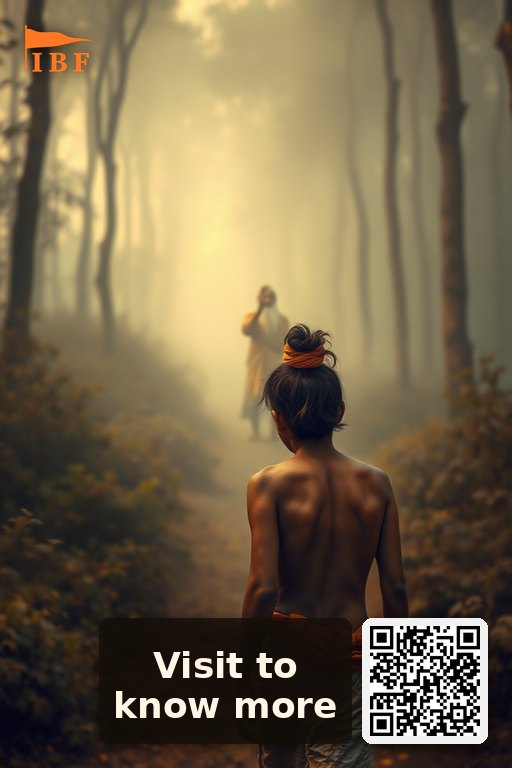
He had one son raised himself. A boy born from a stick of arani-wood as Vyasa was meditating — a son not of a woman but of his concentration.
The boy was called Śuka. By twelve he had surpassed his father in renunciation. He left without saying goodbye and walked into the forest naked, never to return as a householder.
Vyasa followed him weeping. The trees themselves, the chronicles say, answered Śuka when Vyasa called — because Śuka had become one with everything, while Vyasa was still attached to being a father.
It is the most human moment in his life. The man who recorded everything could not, in the end, record his own son back to him.
Still Living, the Tradition Says
Tradition says Vyasa did not die. He was one of the Chiranjīvins — the long-lived ones — and is still seated, somewhere in the Himalayas, watching the parampara he set in motion.
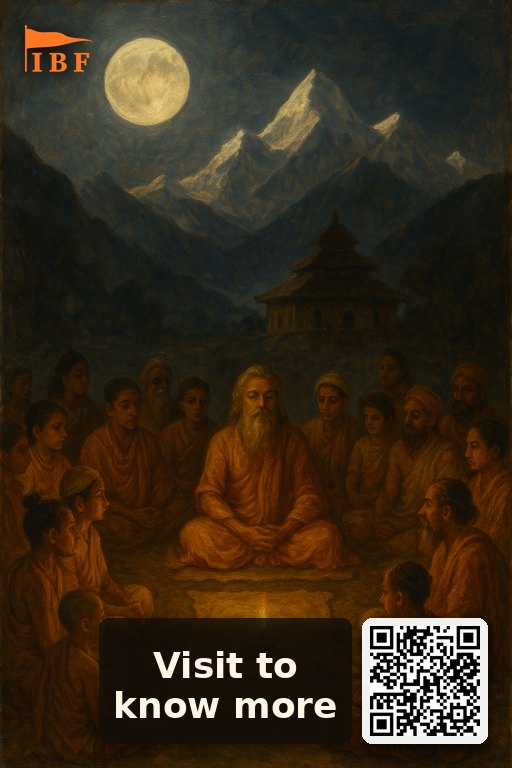
Every Guru Pūrṇimā, on the full moon of Ashadha, Brahmin disciples across the subcontinent honour their teachers. The day's other name is Vyāsa Pūrṇimā. Every Brahmin guru is, in some sense, transmitting Vyasa.
The Vedas he sorted are still being recited, syllable by syllable, in the same intonation pattern, in Brahmin homes from Kerala to Kashi. The Mahābhārata is still being read aloud at deathbeds and weddings. The Gītā is still being taught.
He sat on an island in a river, a Brahmin boy unwilling to let a tradition fall. Three thousand years later, nothing he protected has been lost.
Carry the Story
The Brahmin Federation tells these stories so they are not lost. Share this one. Tell it forward.
He was a Brahmin boy born to a fisher-girl on an island. He divided the Vedas into four. He dictated the Mahabharata to Ganesha. He is the reason any of this survived.
https://brahminfederation.org/legacies/vyasa
Vyasa took the entire body of Vedic knowledge — passed orally for centuries — and divided it into the four Vedas before human memory could fail it. Then he wrote the Mahabharata, which contains the Bhagavad Gita. Every Brahmin parampara begins with him.
https://brahminfederation.org/legacies/vyasa
Vyasa divided the Vedas into four so they would survive. He dictated the Mahabharata. Every Guru Purnima honours him.
https://brahminfederation.org/legacies/vyasa
Veda Vyasa — Brahmin rishi, son of Satyavati and Parashara. Divided the Vedas into four. Wrote the Mahabharata (containing the Bhagavad Gita). Composed the 18 Puranas. Tradition says he is still alive in the Himalayas. #Vyasa #BrahminLegacy #SanatanaDharma #VedaVyasa
https://brahminfederation.org/legacies/vyasa
Three thousand years ago, one Brahmin rishi looked at an oral tradition that no single mind would soon be able to hold and chose to divide it before it fragmented on its own. Vyasa compiled the four Vedas, wrote the Mahabharata and the 18 Puranas, and composed the Brahma Sutras. Every Brahmin guru today is, in some sense, transmitting his preservation work.
https://brahminfederation.org/legacies/vyasa
Or copy the link: https://brahminfederation.org/legacies/vyasa
Know a Brahmin legacy worth preserving?
The Federation is building this archive one story at a time. Send us a name, a tradition, a forgotten manuscript. If it deserves to be told, we'll tell it.