
Aryabhata
Brahmin astronomer. Twenty-three years old. He calculated π. He explained the seasons. He said the earth spins. He wrote it all down in 121 verses.
| Born | 476 CE · Aśmaka country (modern Maharashtra) or Kusumapura (Pataliputra) |
| Died | c. 550 CE |
| Lineage | Brahmin |
| Working life | Nalanda University · Kusumapura observatory |
| Magnum opus | Āryabhaṭīya — composed at age 23, in 499 CE · 121 verses |
| Contributions | Place value system · zero · π to 4 decimals · spherical earth · earth's rotation · cause of eclipses |
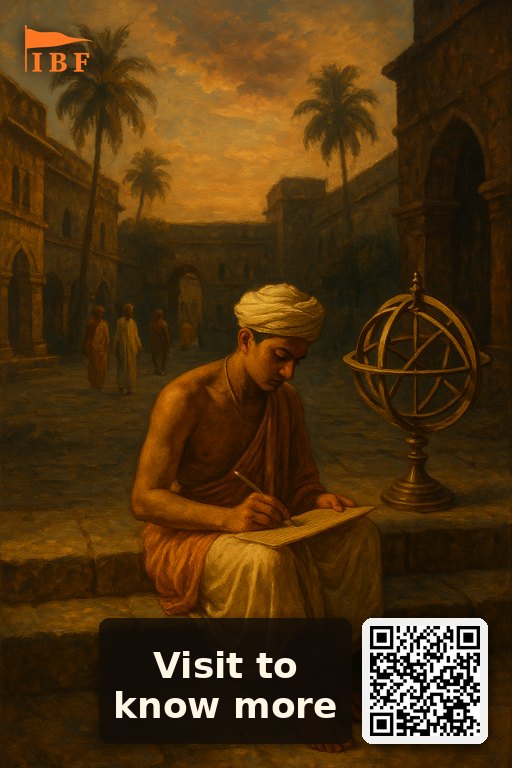
The Brahmin Boy at Kusumapura
He was born in 476 CE, in the Gupta age — the golden centuries of post-Vedic civilisation when Brahmin mathematics, astronomy, medicine and literature were reaching their classical height.
The location is disputed. The Brahmin tradition that produced him is not. He was educated in Kusumapura — Pataliputra, modern Patna — at one of the great Brahmin gurukulas in the heart of the empire that Chanakya had built eight centuries before.
By his early twenties he was being noticed. The Aryabhatiya itself opens by stating its place of composition: Kusumapure 'bhyarcitaṃ jñānam — the knowledge that is honoured at Kusumapura.
The Move to Nalanda
Then he moved north-east, to Nalanda — the greatest Buddhist university in the world at the time, which nonetheless retained working Brahmin scholars in mathematics, astronomy and Sanskrit grammar.
Nalanda was a city of nine million books, sixteen thousand students, and an observatory on its highest stupa. The astronomy teachers were Brahmins. The mathematics teachers were Brahmins. The languages were Sanskrit and Pali, taught side by side.
This was where Aryabhata did his actual computational work — at twenty-three years old, while teaching beginners his other subjects.

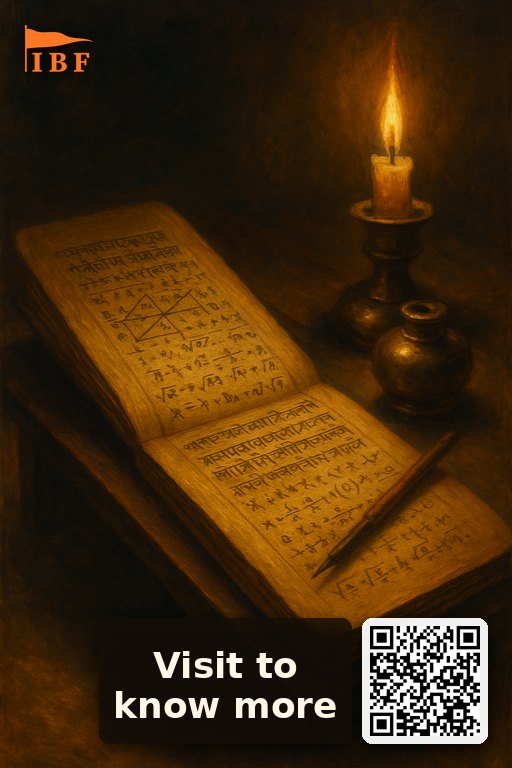
The Aryabhatiya
He wrote the Āryabhaṭīya in 499 CE.
Four sections. One hundred and twenty-one verses. Sanskrit so compressed that single ślokas contain entire mathematical operations:
| Pāda | Subject | Verses |
|---|---|---|
| Gītikā | Definitions · alphabetic numerals · table of sines | 13 |
| Gaṇita | Mathematics — arithmetic, algebra, trigonometry | 33 |
| Kālakriyā | Time-reckoning · planetary positions | 25 |
| Gola | The sphere — celestial geometry, eclipses, rotation | 50 |
It is the most compact treatise on advanced mathematics ever produced in any tradition. A modern textbook covering the same ground would run a thousand pages.
“Caturadhikaṃ śatamaṣṭaguṇaṃ dvāṣaṣṭistathā sahasrāṇām — 100 + 4, multiplied by 8, plus 62,000: the circumference of a circle whose diameter is 20,000.”
What He Calculated
What did he actually compute?
The place-value decimal system with a position for zero. Brahmin mathematics had been moving toward this for centuries; Aryabhata's verses are the first surviving treatment that uses it operationally for arithmetic.
π = 3.1416. Correct to four decimal places, six hundred years before any non-Indian mathematician would match it. He also stated, in the same verse, that this value is āsanna — "approximate." He knew it was irrational.
Sine tables. The half-chord function — what we now call sin(θ) — at intervals of 3.75°. The Sanskrit word he used was jyā. It travelled to Arabic as jiba, was misread as jaib meaning "pocket," and became Latin sinus. The word "sine" in every European language is a corruption of Aryabhata's term for a half-chord.
Quadratic equations. Indeterminate equations (kuṭṭaka). Series sums. Volumes of spheres.
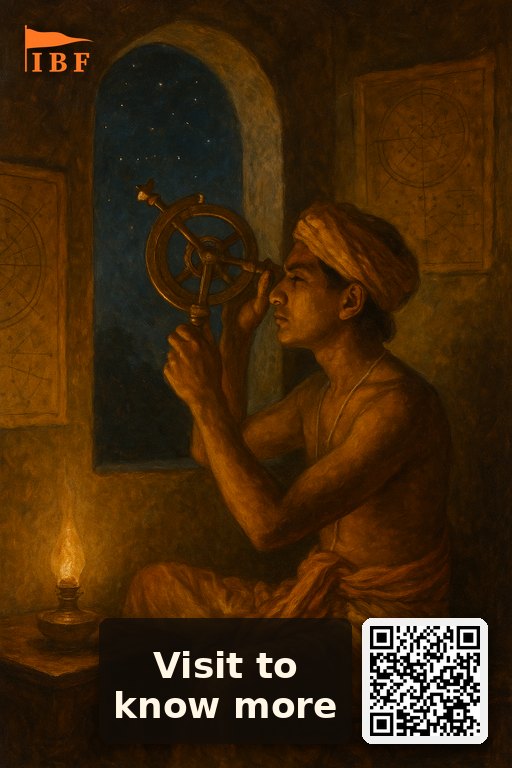
What He Saw
He looked at the night sky and saw what no one had previously dared to write down.
The earth is a sphere, not a flat disc, and stands suspended in space without support. He gave its circumference: 24,835 miles. Modern value: 24,901 miles. He was off by 0.3%.
The seasons are caused by the earth's tilt relative to its orbital plane.
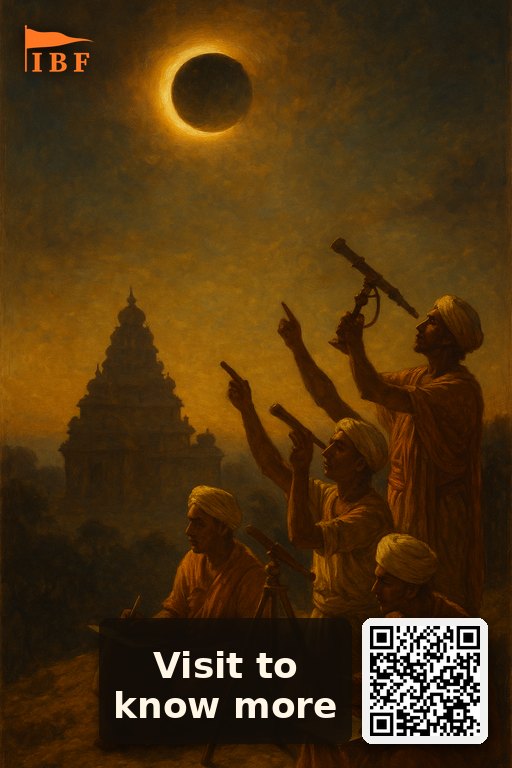
Eclipses are caused by the shadow of the moon falling on the earth (solar eclipse) or the shadow of the earth falling on the moon (lunar eclipse). Not by the mythological demons Rahu and Ketu swallowing them. He stated this in verse. The Brahmin astronomical tradition after him continued to use "Rahu and Ketu" as labels for the shadow nodes — but the mechanism was understood.
“Anulomagatir naustho aśama dṛṣṭā acalaṃ vibhāgataḥ — Just as one in a moving boat sees the trees on the bank moving in the opposite direction, so the stars appear to move while the earth rotates.”
The Earth Spins
And then this — the line that no one in Europe would dare to state for another thousand years:
Anulomagatir naustho aśama dṛṣṭā acalaṃ vibhāgataḥ.
"Just as one in a moving boat sees the trees on the bank moving in the opposite direction, so the stars appear to move while the earth rotates."
The earth spins on its axis. The stars are stationary. The apparent motion of the heavens is an effect of our motion, not theirs.
This was 499 CE. Copernicus would not be born for another thousand years.
Later Brahmin astronomers — Brahmagupta, Bhāskara I, Bhāskara II — would refine, correct, occasionally disagree. The conversation was alive. The framework was Aryabhata's.

Translated into Arabic
By the 8th century, the Āryabhaṭīya had been translated into Arabic at Baghdad's House of Wisdom. The translator was an Indian Brahmin scholar called Kaṅka. The Caliph al-Mansur paid for it.
The Arabs read it. They absorbed the decimal place-value system, sine tables, π. They called Aryabhata Arjabhar and treated him as one of their primary sources.
From Arabic, the system reached Cordoba, then Toledo, then Christian Europe through translation in the 12th century. The numerals you use to write a phone number — 0 through 9, with positional value — came from Aryabhata via Baghdad via Cordoba via Toledo into the everyday accounting of Florence and Venice.
Every time anyone, anywhere on earth, writes "2026," they are using a Brahmin invention.
The Satellite
India launched its first satellite in April 1975. It was called Aryabhata. It carried instruments to study cosmic rays, solar physics, X-ray astronomy. It orbited successfully for sixteen years.
The Brahmin who had first explained the rotation of the earth from a Nalanda observatory had a piece of metal placed in orbit around it, fifteen hundred years later, by the country that came out of the empire he had once helped to administer.
His birthplace is contested. His school is gone — Nalanda was burned to the ground by Bakhtiyar Khilji in 1193 CE. His sine tables are obsolete.
His method of asking — measure the sky, write down what you see, doubt the myth, refine the answer — is now the entire scientific civilisation he never lived to see. That method is Brahmin. He authored it.
Carry the Story
The Brahmin Federation tells these stories so they are not lost. Share this one. Tell it forward.
He was 23 years old. He calculated π to 4 decimals. He explained eclipses. He said the earth spins on its axis. He wrote it all down in 121 Sanskrit verses. Aryabhata. 476-550 CE. A Brahmin from Kusumapura.
https://brahminfederation.org/legacies/aryabhata
Aryabhata wrote the Aryabhatiya in 499 CE at the age of 23, while teaching at Nalanda University. He gave us the place-value decimal system with zero, π to four decimal places, sine tables (the word 'sine' in every European language is a corruption of his Sanskrit jyā), and the rotation of the earth on its axis — a thousand years before Copernicus. The numerals you use to write today's date came from him via Baghdad to Cordoba to Europe.
https://brahminfederation.org/legacies/aryabhata
Aryabhata — Brahmin astronomer of Nalanda, 5th century CE. Gave the world zero, π, sine tables, and the spinning earth. India's first satellite was named after him.
https://brahminfederation.org/legacies/aryabhata
Aryabhata. Brahmin, age 23. Wrote the Aryabhatiya at Nalanda in 499 CE. Gave the world: zero · place-value decimals · π to 4 decimals · sine tables · spherical earth · earth's rotation on its axis · cause of eclipses. 1500 years later, India's first satellite was named after him. #Aryabhata #BrahminScience #Nalanda #IBF
https://brahminfederation.org/legacies/aryabhata
In 499 CE a 23-year-old Brahmin astronomer at Nalanda University wrote a 121-verse treatise that introduced the place-value decimal system with zero, calculated π to four decimal places, and explained that the apparent motion of the stars is caused by the earth's rotation — a thousand years before any European astronomer would dare propose it. Every time you write a number with positional digits, you use Aryabhata's invention. India's first satellite is named after him for a reason.
https://brahminfederation.org/legacies/aryabhata
Or copy the link: https://brahminfederation.org/legacies/aryabhata
Know a Brahmin legacy worth preserving?
The Federation is building this archive one story at a time. Send us a name, a tradition, a forgotten manuscript. If it deserves to be told, we'll tell it.