
Adi Shankaracharya
Brahmin. Sannyāsi. The boy who walked across India to save a civilisation — and finished by thirty-two.
| Born | c. 788 CE · Kaladi, Kerala |
| Died | c. 820 CE · Kedarnath, Himalayas |
| Lineage | Nambudiri Brahmin · Yajurvedic |
| Tradition | Advaita Vedānta · non-dualism |
| Founded | Sringeri · Dwaraka · Puri · Jyotirmath — still operating, 1,200+ years |
The Boy by the River
The Periyar river runs slow at Kaladi.
In 788 CE, on its banks, a Nambudiri Brahmin couple held their newborn son. Shivaguru and Aryamba had waited years. They had prayed at Vadakkunnathan. They had observed every vow. And finally — a boy.
They named him Shankara. The auspicious one.
The Nambudiris were not just any Brahmins. Keepers of the Yajurveda. Custodians of temple fire. Guardians of a Sanskritic order that had survived where elsewhere it was fraying. Into this lineage, Shankara was born.
Shivaguru died when the boy was three. Aryamba raised him alone.
By eight, Shankara had done what most could not finish in a lifetime. All four Vedas, memorised. The Brahma Sūtras, read. Sanskrit, mastered.
And he had decided.
Then came the river.
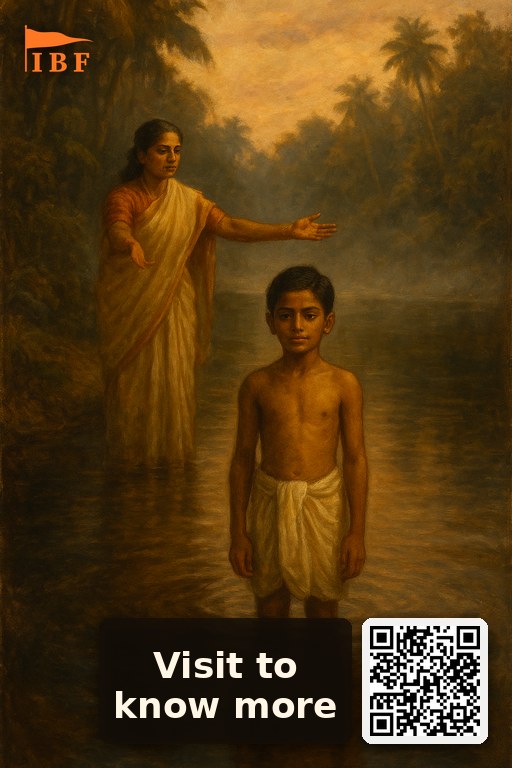
The boy was bathing in the Periyar when a crocodile seized his leg. He did not struggle. He called out to his mother.
"Mother — let me become a sannyāsi. Give me your blessing. The crocodile will not release me otherwise."
Aryamba had only one son. He was eight. She gave him her blessing.
The crocodile let go.
Tradition has told this story for twelve hundred years. The crocodile may not have been real. The choice was.
He made one promise before he left: whenever his mother was dying, he would return to perform her last rites. He kept it. Decades later, against every monastic rule, he would touch her body and light her pyre. Because for a Brahmin son, the duty owed to a mother outranks the rule.
Then, with her permission, he turned north. A Brahmin boy of eight, walking alone, looking for a guru.
The Guru in the Cave
He walked. Through forest. Past temple towns. Across rivers older than his lineage.
On the southern bank of the Narmada, near Omkareshwar, in a cave half-hidden by rock, lived an old sannyāsi. Govindapāda. His own guru had been Gauḍapāda — the man who had stitched the four Upaniṣadic Mahāvākyas back into a single teaching when no one else had dared.
The line was unbroken. Gauḍapāda had received Advaita from his guru, who from his, all the way back to Vyāsa and the Veda itself. This is the parampara — the unbroken Brahmin chain of teacher to student. Breath to breath. Mantra to mantra.
Govindapāda was the keeper of that chain. Shankara had come for it.
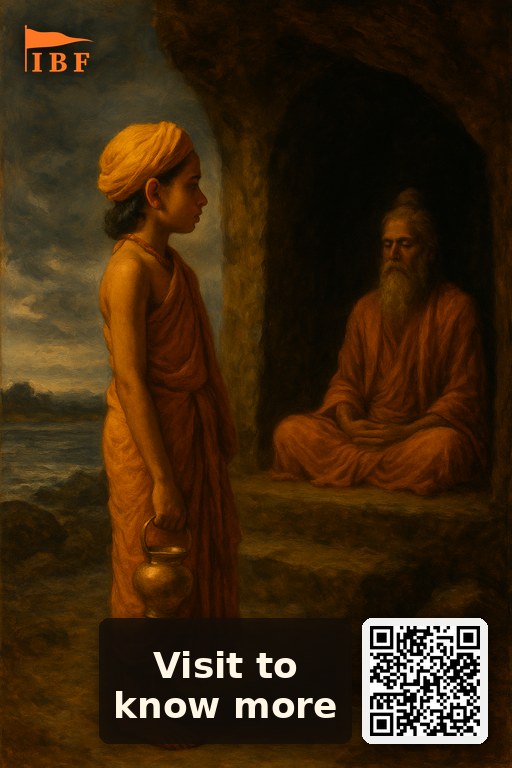
The boy stood at the mouth of the cave. Tradition says Govindapāda asked: "Who are you?"
"I am not the body. I am not the mind. I am not the senses. I am That."
The old man rose. He had been waiting for this disciple his whole life.
What followed was years. In that cave, Govindapāda gave his student the four great sayings of the Vedas:
| Mahāvākya | Meaning | Veda |
|---|---|---|
| Prajñānaṃ Brahma | Consciousness is Brahman | Ṛgveda |
| Ayam Ātmā Brahma | This Self is Brahman | Atharvaveda |
| Tat Tvam Asi | That — thou art | Sāmaveda |
| Ahaṃ Brahmāsmi | I am Brahman | Yajurveda |
One sentence per Veda. Together, the entire architecture of Advaita Vedānta — the philosophical inheritance every Brahmin scholar before him had been the keeper of. Now it had a new keeper.
Then came the flood. The Narmada rose without warning, the colour of iron, coming for the cave. Govindapāda was deep in samādhi — unreachable.
Shankara picked up his guru's water-pot. He walked to the mouth of the cave. He held the kamaṇḍalu out toward the river.
And the river poured into it. All of it. And stopped.
Govindapāda opened his eyes. "Go to Kāshī. The world is waiting."
“Worship Govinda. Worship Govinda. Worship Govinda — O fool of a mind. When the time of death comes, no rule of Sanskrit grammar will save you.”
The Work
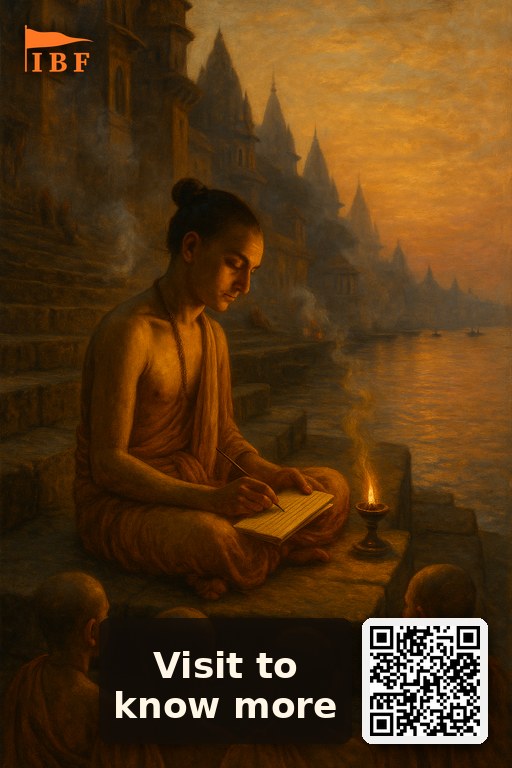
Kāshī. Banaras. The city of light.
When Shankara arrived at the ghats of the Ganga, he was perhaps twelve. He sat down by the river. And he wrote.
Commentary on the Brahma Sūtras. Commentary on the Bhagavad Gītā. Commentaries on ten principal Upaniṣads — Īśa, Kena, Kaṭha, Praśna, Muṇḍaka, Māṇḍūkya, Taittirīya, Aitareya, Chāndogya, Bṛhadāraṇyaka.
He was sixteen years old.
This is the Prasthāna-trayī — the three foundations of Vedānta. No one before him had commentated on all three. No one had argued non-dualism from each with the others as witnesses.
He did it in Sanskrit so clear that for twelve hundred years, every serious Brahmin student of philosophy has read his bhāṣyas first — even the Vishishtadvaitins and the Dvaitins who disagree with every conclusion. You cannot argue against Shankara without first knowing him.
The corpus did not stop there. The Vivekachūḍāmaṇi — the Crest-Jewel of Discrimination. The Bhaja Govindam — twelve simple verses still chanted in Brahmin homes today. The Saundarya Lahari for the Devi. The Dakṣiṇāmūrti Stotra for Shiva. Hymns to every deity.
For Shankara, the Brahmin tradition was not narrow. The same Brahman that the Upaniṣads pointed to could be approached through any deity, any path, any river — because there is no second.
By twenty, his work was nearly done. What remained was to defend it. He set out on the Digvijaya. The conquest of directions.
The Debate at Māhiṣmatī
Maṇḍana Miśra was the greatest Brahmin ritualist of his age. He lived at Māhiṣmatī, in a house famous from a thousand miles away: the parrots on his veranda did not chant slogans. They recited Vedic mantras.
Maṇḍana was Pūrva-Mīmāṃsā — ritual is the highest knowledge, the householder's yajña is the true path, renunciation is a distraction. Shankara was everything against this.
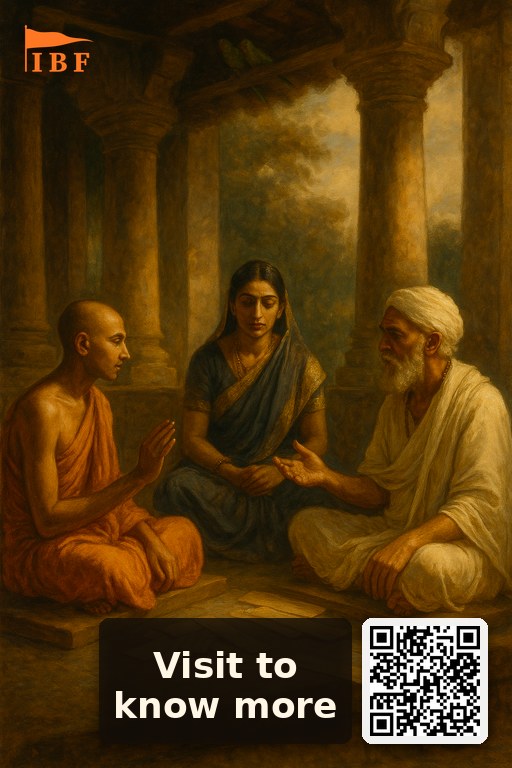
The debate lasted weeks. The rule was set: loser adopts winner's path. If Maṇḍana lost, sannyāsa. If Shankara lost, marriage.
The umpire was unexpected: Maṇḍana's own wife, Ubhaya Bhāratī — a scholar in her own right, said to be an avatāra of Saraswati.
Day after day. Every text cited, every interpretation contested.
Maṇḍana lost. He shaved his head. He took sannyāsa. He became Sureśvara — one of Shankara's four chief disciples.
But then Ubhaya Bhāratī spoke: "I am his wife. We are one. You have defeated only half of him. Defeat me too — or the victory is incomplete."
And she asked Shankara about marital life. Kāmaśāstra. The intimate knowledge of the householder.
Shankara, a brahmacārī sannyāsi since the age of eight, had no answer. He asked for a month.
What happened in that month is the most disputed episode in his life. Tradition says he found the recently dead king Amaruka and, through yogic power, transferred his consciousness into the dead body — ruled the king's harem for weeks, learned what he had to learn, and returned. The orthodoxy was scandalised. The yogic schools said: of course. The body is not the Self.
He came back. He answered her questions. She accepted his victory.
It is the strangest story in his life — and the most telling. Even a Brahmin sannyāsi who had renounced everything would do whatever it took to keep the tradition alive. The teaching mattered more than the appearance.
“Brahma satyaṃ jagat-mithyā jīvo brahmaiva nā'paraḥ. — Brahman alone is real. The world is appearance. The Self is none other than Brahman.”
Opposition and Answer
Not everyone in Brahmin India loved Shankara.
The Mīmāṃsakas thought him too dismissive of ritual. The Buddhists called his Advaita crypto-Buddhism with extra steps. The Vaiṣṇavas thought him a closet atheist.
Centuries after he was gone, two more Brahmin ācāryas would rise to oppose him in writing. Rāmānujācārya would compose the Śrī Bhāṣya specifically to refute Shankara. Madhvācārya would compose his own Brahma Sūtra commentary specifically against him. Both were brilliant. Both were Brahmins. Both were partly right.
Shankara never lived to read them.
But he had already written the answer. The answer was the parampara — the chain. Read my bhāṣyas first. Then disagree.
Twelve hundred years later, every Vedānta student does exactly that. The disagreement keeps the conversation alive. The agreement on the question — what is Brahman, what is the Self — keeps the tradition alive.
This is the second great Brahmin gift Shankara left behind: not just an answer, but an unanswerable framing of the question.
The Four Mathas
He had crossed the subcontinent debating. He had won. But arguments fade. Institutions do not.
So Shankara built four.
| Matha | Direction | Veda |
|---|---|---|
| Sringeri Sharada Peetham | South · Karnataka | Yajurveda |
| Dwaraka Peetham | West · Gujarat | Sāmaveda |
| Puri Govardhana Peetham | East · Odisha | Ṛgveda |
| Jyotirmath | North · Uttarakhand | Atharvaveda |
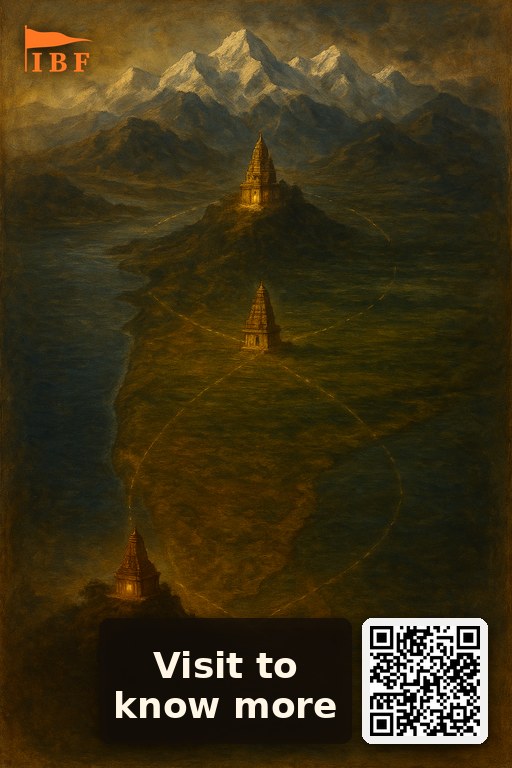
Four Mathas. Four directions. Four Vedas. One unbroken Brahmin order — the Daśanāmi Sampradāya — to guard the teaching after he was gone.
Each Matha received a Veda, a region, a senior disciple as its first Śaṅkarāchārya, and an unbroken succession. Twelve hundred years later, there is still a sitting Śaṅkarāchārya at each one. They still teach Sanskrit. They still administer temple worship. They still rule on dharma when the community asks.
A thirty-year-old built four institutions, and they are still in operation today. There is no comparable feat in world religious history.
The Brahmin order he forged is the longest continuously functioning religious-philosophical institution on earth.
In His Own Words
Three lines, in Sanskrit and English, from works whose attribution is reliably attested.
From the Nirvāṇa Ṣaṭkam
Mano-buddhi-ahaṅkāra-cittāni nāhaṃ.
"I am not the mind, intellect, ego, or memory."
From the Bhaja Govindam
Bhaja Govindaṃ Bhaja Govindaṃ Govindaṃ Bhaja mūḍha-mate.
"Worship Govinda. Worship Govinda. Worship Govinda — O fool of a mind."
From the Vivekachūḍāmaṇi
Brahma satyaṃ jagat-mithyā jīvo brahmaiva nā'paraḥ.
"Brahman alone is real. The world is appearance. The Self is none other than Brahman."
The Walk to Kedarnath
He kept his promise.
When Aryamba was dying in Kaladi, he came. He performed her cremation against every monastic rule. He sang her into the next life with mantras only a Brahmin son can sing for his mother.
Then he walked north one more time.
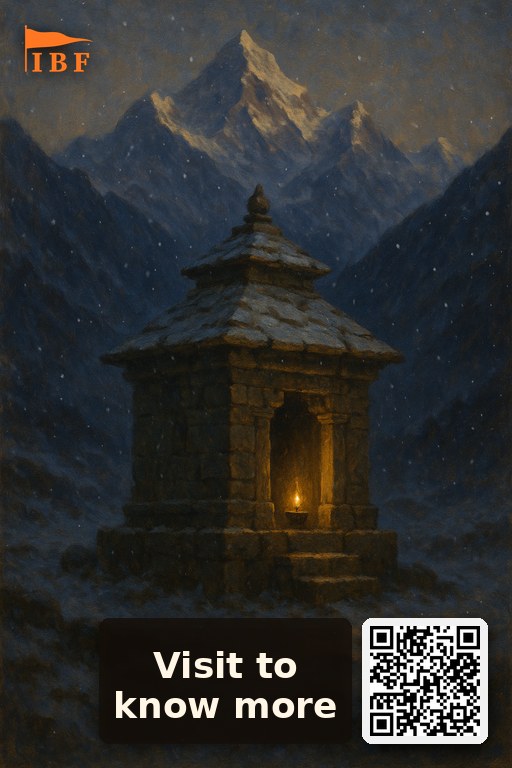
He climbed into the Himalayas. He reached Kedarnath — the shrine of Shiva in the high valley where the snow does not melt. He sat down behind the shrine.
He was thirty-two.
Tradition says he did not die. Tradition says he walked into the rock face behind the temple and disappeared.
What we know: at Kedarnath, behind the Jyotirlinga, there is a small stone samādhi. The plaque names the figure interred or commemorated there. It says: Adi Shankarāchārya.
He had walked all of India. He had written the Prasthāna-trayī. He had won every debate. He had founded the four mathas. He had buried his mother.
He was thirty-two.
The civilisation he re-stitched is still here. So is the Brahmin order he built to guard it.
Carry the Story
The Brahmin Federation tells these stories so they are not lost. Share this one. Tell it forward.
He was a Brahmin boy of eight. He walked alone, north, looking for a guru.
He would not stop walking until he had re-stitched a civilisation.
788-820 CE · 32 years · 4 mathas still standing.
https://brahminfederation.org/legacies/adi-shankaracharya
Born to a Nambudiri Brahmin couple in Kerala, 788 CE. By thirty-two, he had walked the length of India, won every philosophical debate, and founded the four mathas that still stand today.
He did all of it as a Brahmin.
https://brahminfederation.org/legacies/adi-shankaracharya
A Brahmin boy of eight walked alone across India in search of a guru. By thirty-two, he had re-stitched a civilisation.
Adi Shankaracharya — 788-820 CE.
https://brahminfederation.org/legacies/adi-shankaracharya
Adi Shankaracharya. Born to Nambudiri Brahmins in Kerala, 788 CE.
By 8 → all four Vedas memorised.
By 16 → wrote the Prasthāna-trayī.
By 32 → walked all of India, founded four mathas still standing.
#BrahminLegacy #IBF #SanatanaDharma
https://brahminfederation.org/legacies/adi-shankaracharya
Twelve centuries before the modern Indian nation, one Nambudiri Brahmin walked the entire subcontinent on foot.
He left home at eight. He died at thirty-two. He founded four institutions still operating today — the longest continuously functioning religious-philosophical order on earth.
https://brahminfederation.org/legacies/adi-shankaracharya
Or copy the link: https://brahminfederation.org/legacies/adi-shankaracharya
Know a Brahmin legacy worth preserving?
The Federation is building this archive one story at a time. Send us a name, a tradition, a forgotten manuscript. If it deserves to be told, we'll tell it.