
Sir C. V. Raman
Brahmin physicist. The first non-white Asian scientist to win the Nobel Prize. He looked at the Mediterranean from a ship's deck and asked one question — and the answer rewrote optics.
| Born | 7 November 1888 · Tiruvanaikaval, Tamil Nadu |
| Died | 21 November 1970 · Bangalore |
| Lineage | Tamil Iyer Brahmin |
| Education | Presidency College, Madras — MA Physics at 18 |
| Nobel Prize | 1930 — Physics, for the Raman Effect |
| Discovery | Raman scattering · 28 February 1928 · Kolkata |
| Founded | Indian Academy of Sciences · Raman Research Institute, Bangalore |
| Honours | Knighted 1929 · Bharat Ratna 1954 |
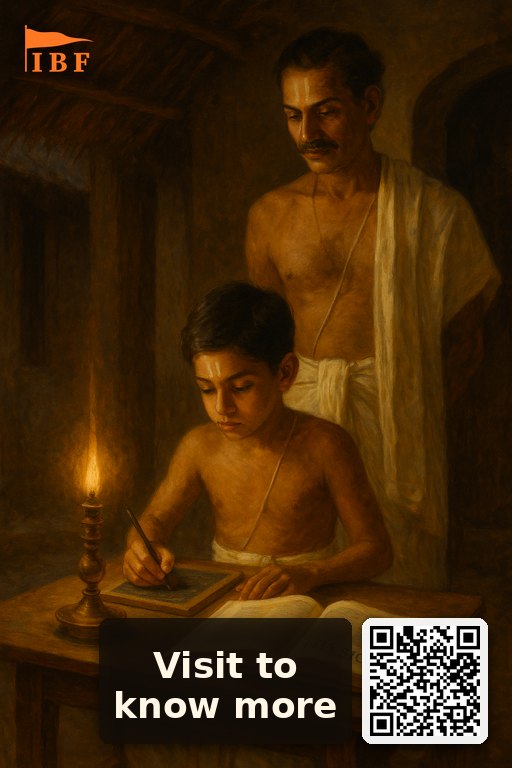
The Boy Who Read Helmholtz at Fourteen
He was born on 7 November 1888 in Tiruvanaikaval, a village near Tiruchirappalli in Tamil Nadu, to Chandrasekhara Iyer — a Tamil Iyer Brahmin schoolteacher of mathematics and physics, the first in his line to have a modern education — and Parvati Ammal.
The household was traditional. The boy learned Sanskrit and the Tamil Vedic chanting from his father in the morning, and Newton and Maxwell in the afternoon.
By twelve he had finished school. By fourteen he had read Helmholtz's Sensations of Tone in English, cover to cover, and could discuss acoustic resonance with his father in Tamil.
He topped his BA at Presidency College, Madras, at sixteen — the first to do so in physics. He topped his MA there at eighteen. He published his first physics paper in the Philosophical Magazine of London at nineteen. He was the youngest Indian to publish in that journal ever.
The Voyage Across the Mediterranean
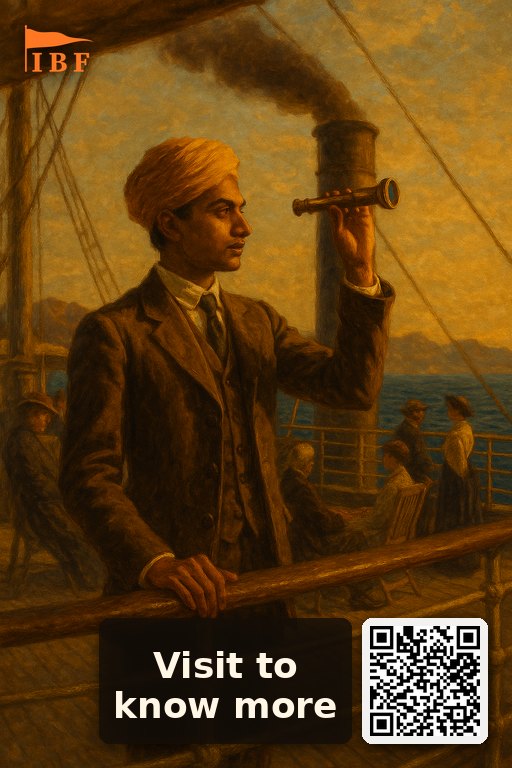
In 1921, at thirty-three, Raman was sent to England as a delegate to the Universities Congress at Oxford.
He travelled by ship. On the deck of the SS Narkunda, on the return voyage in mid-September, crossing the Mediterranean, he stood at the railing one afternoon and looked at the sea.
It was blue. The standard explanation — Lord Rayleigh's, accepted by everyone — was that the sea was blue because it reflected the blue sky.
Raman thought about it. He had a small spectroscope in his cabin. He set it up at the railing, pointed at the water, and shielded the instrument from the sky. The sea was still blue.
The reflection theory was wrong. The water itself was doing something to the light. He had no idea what. By the time the Narkunda docked at Bombay he had decided what his next ten years of work would be.
“Why is the sea blue? The official answer of the Royal Society in 1920 was: because the sky is blue. I did not find that satisfactory.”
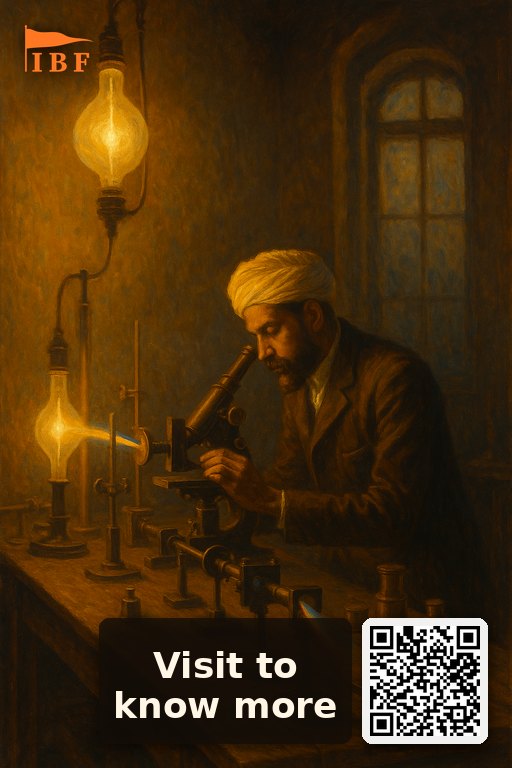
Calcutta, 1917
He returned to Calcutta, where he had been working since 1907 — first at the Indian Finance Department (a day job to support his family), then increasingly at the Indian Association for the Cultivation of Science (IACS), where he had been given lab space by Mahendralal Sircar's society.
In 1917 he resigned the Finance Department job to take the Palit Chair of Physics at Calcutta University — a 50% pay cut. His family disapproved. He went anyway.
The IACS lab was modest. A few benches, a spectroscope, prisms, mercury lamps. Raman ran the optics work himself, often into the early morning. He recruited brilliant young Brahmin students — K. S. Krishnan, A. S. Ganesan, K. R. Ramanathan — and trained them.
For seven years he worked on the optics of liquids. The sea question was always underneath.
The Spectrometer
On the evening of 28 February 1928, Raman was at his spectroscope in the IACS lab. He was shining filtered violet light through liquid samples and measuring what came out.
Most of the light came out at the same colour. A tiny, tiny fraction came out at different colours — shifted slightly toward red or blue. The shifts were small. They were also specific to the molecule the light had passed through.
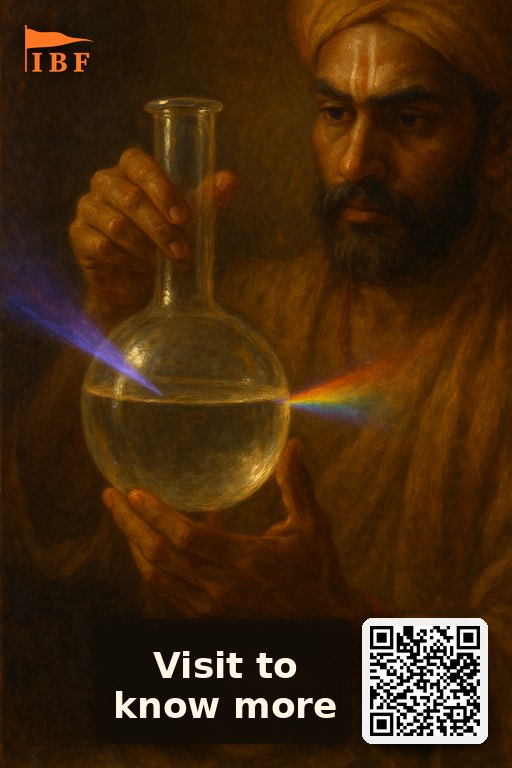
He understood what he was seeing. Light, hitting a molecule, exchanges energy with it — gains energy from one of the molecule's vibrational modes, or loses energy to it. The light comes out at a slightly different wavelength. The shift is a fingerprint of the molecule.
This is the Raman Effect. Inelastic scattering of light by molecular vibrations.
The Mediterranean was blue because water molecules were inelastically scattering sunlight, and the bulk effect favoured blue. The reflection theory had been wrong all along.
He sent the paper to Nature. They published it on 31 March 1928.
Stockholm, 1930
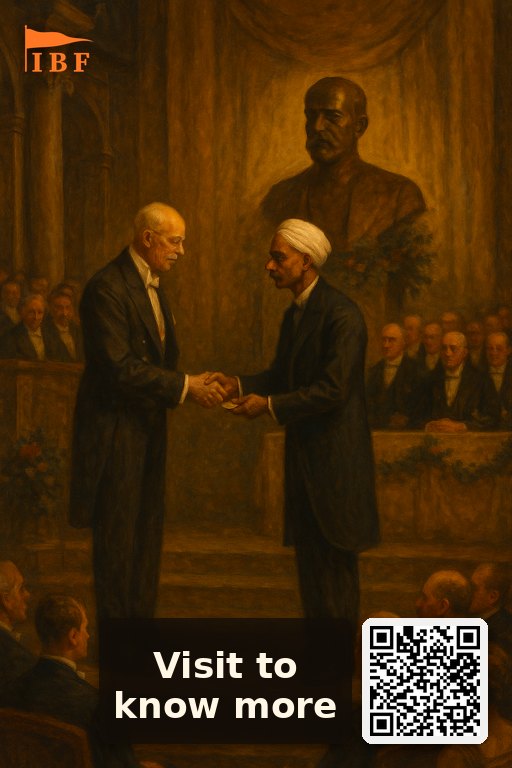
The Nobel committee deliberated for two years. On 10 December 1930, Raman walked onto the stage in Stockholm and received the Nobel Prize in Physics.
He was the first non-white scientist of any discipline to win a Nobel. He was also the first Asian. The first Indian. The first Brahmin.
At the banquet, asked to speak, he made a single short remark about gratitude for opportunity — and then said the line that summarises everything he stood for: physics works in Sanskrit, English, and silence — and only requires that you pay attention.
He had paid attention to a colour for ten years. The Nobel Prize was the world's way of saying: yes, that is enough.
“I am not the man you think I am. I am a Tamil Brahmin who is grateful that physics works in Sanskrit, English, and silence — and only requires that you pay attention.”
Founding an Indian Science
Raman did not coast on the Nobel. In 1934 he moved to Bangalore as director of the Indian Institute of Science. He founded the Indian Academy of Sciences. In 1948 he founded the Raman Research Institute — a small private lab where he and a handful of Brahmin and non-Brahmin Indian students would work on optics, crystals, and the physiology of vision for the next twenty-two years.
He published two hundred and fifty more papers between the Nobel and his death. He trained generations. He turned down every honour that required him to leave India. He refused multiple chairs at Cambridge and Princeton.
Brahmin science had to be done in India, by Indians, with Indian students. That was his position. He held it for forty years.
Why Raman Scattering Matters
The Raman Effect is not just a historical achievement. It is, today, one of the most widely used analytical techniques in any laboratory on earth.
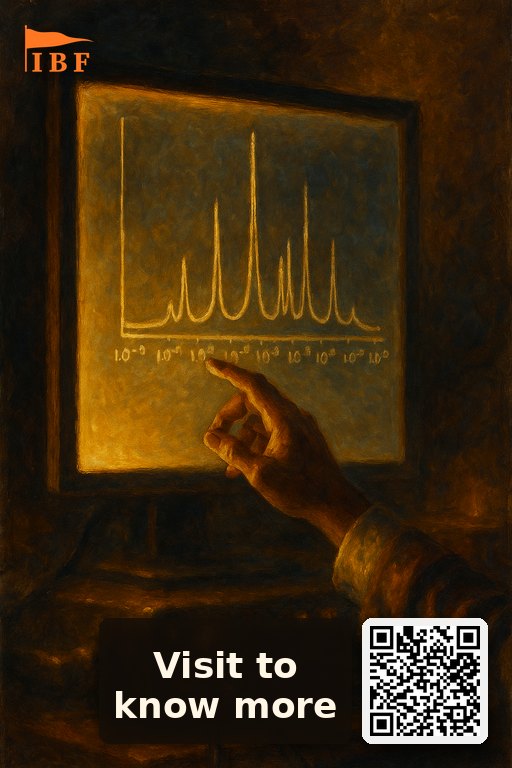
Raman spectroscopy identifies molecules by their vibrational fingerprints. It is used in pharmaceutical manufacturing to verify drug purity. It is used by forensic scientists to identify trace evidence. It is used by Mars rovers to identify minerals. It is used in art conservation to authenticate paintings. It is used in cancer diagnosis.
Every time anyone, anywhere on earth, uses a Raman spectrometer — and they are everywhere — they are using a Brahmin discovery.
National Science Day
India declared National Science Day on 28 February — the date of Raman's discovery in 1928. It is observed every year in every school and laboratory in the country.
Raman died on 21 November 1970, two weeks after his 82nd birthday, at his institute in Bangalore. He had been working in the lab a few days before. His final wish was that his ashes be scattered in the garden of the Raman Research Institute, not given a public ceremony. I have done my work. Let me be quiet.
Brahmin science in modern India did not begin with him. It came of age with him. He showed, by example, that a Tamil Iyer schoolteacher's son could ask a question on a ship deck and end with a result that rewrote the optics textbook.
The Vedic injunction is satyam vada — speak the truth. Raman spent his whole life proving that the scientific method is one way of doing exactly that.
Carry the Story
The Brahmin Federation tells these stories so they are not lost. Share this one. Tell it forward.
He looked at the Mediterranean from a ship's deck and asked one impertinent question: why is the sea blue? The answer made him the first non-white scientist to win a Nobel Prize. C. V. Raman. Tamil Iyer Brahmin. 1888-1970.
https://brahminfederation.org/legacies/cv-raman
On 28 February 1928, in a modest lab in Calcutta, a Tamil Iyer Brahmin physicist named C. V. Raman noticed that a tiny fraction of light passing through liquid came out at a slightly different colour — a fingerprint of the molecule it had passed through. Two years later, he won the Nobel Prize in Physics. The discovery — Raman scattering — is now one of the most widely used analytical techniques on earth.
https://brahminfederation.org/legacies/cv-raman
C. V. Raman — Tamil Brahmin physicist, Nobel laureate 1930. Discovered the Raman Effect on 28 February 1928 in Calcutta. India observes that date as National Science Day.
https://brahminfederation.org/legacies/cv-raman
Sir C. V. Raman. Tamil Iyer Brahmin physicist. Discovered Raman scattering 28 Feb 1928. First non-white scientist to win the Nobel (1930). Founded the Raman Research Institute, Bangalore. India observes his discovery date as National Science Day. #CVRaman #BrahminScience #NobelPrize #IBF
https://brahminfederation.org/legacies/cv-raman
In 1928, a Tamil Iyer Brahmin physicist in a modest Calcutta laboratory discovered that molecules leave a fingerprint on the light passing through them. Two years later, C. V. Raman became the first non-white scientist in history to win the Nobel Prize in Physics. Raman spectroscopy is now used in pharmaceuticals, forensics, Mars rovers, cancer diagnosis, and art conservation. He turned down every offer to leave India and built three research institutes here instead.
https://brahminfederation.org/legacies/cv-raman
Or copy the link: https://brahminfederation.org/legacies/cv-raman
Know a Brahmin legacy worth preserving?
The Federation is building this archive one story at a time. Send us a name, a tradition, a forgotten manuscript. If it deserves to be told, we'll tell it.